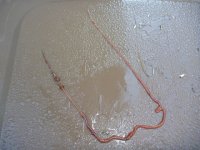
What's this worm? (Don't open message while eating...)

Icemaiden

Well-known member
Joined
Sep 27, 2012
Messages
1,478
Reaction score
161
Location
Kent
worm 50cm long.jpg
Please can anyone tell me what kind of worm this is? I found it in one of the girls' poos the other day while poo picking the coop. It was intact and alive, which makes me doubt whether it's a skinny earthworm that had been eaten... It had definitely been excreted.

It was kind of folded in half in the poo, but when straightened out appeared to be around 50cm long, 2mm in cross section, pinkinsh red in colour.

The girls were due a course of Flubenvet anyway, which they're about to start, but it'd be helpful to know what the culprit is. Worms that I've found in line don't sound to be this long. Any ideas please?
 
I've never seen one like that either Icemaiden. Roundworms I've seen in poos are white and usually about 50mm long, so a tenth of the length. If it has visible segments it could be a small tapeworm perhaps but I thought they were white as well? I had only seen the segments until last week when the neighbour's cat tried to sick one up and failed, having to swallow it back -horrible! Flubenvet won't kill tapeworm I am told, although it worked with ours 4 years ago, which is a bit puzzling? But there are other types of intestinal worms I think? Now you mention it though I have seen something like that on more than one occasion, but they were a lot smaller, dead and assumed to be part-digested earthworm.

I Googled 'intestinal worms in cats pictures' and saw a worm similar to that. Perhaps you need to worm more regularly? We've found that 6 months is too long because there are signs with ours at about 4 months.
 
Spotted a strange watery poo in the Buff Orpington's enclosure yesterday. Close examination revealed a worm exactly like that Icemaiden, although somewhat smaller. This was about 1mm diameter and 20cm long -dead, but completely intact. Certainly not an earthworm because they are rare here and huge- too big for a chicken to swallow whole.

They have all been wormed with Flubenvet except one. We bought a French Buff Orpington to keep Bottom company. She arrived with no feathers on her back half at all. She was omitted from the worming because she was moulting and covered in little spiky feathers, none of which we wanted to damage (we worm by dropper). So that will be one of todays jobs.
 
Well the girls are just on the last of their flubenvet & are going stir crazy, having been confined to their run all week. It's probably not how Varta had hoped to spend her henniversay (2 years free from her battery cage last Tuesday), but I'll make it up to her next week.
I must post some "before" & "after" photos of her- the transformation is amazing. 0:-)
 
Hi Chris, to what concentration to you mix up the Flubenvet and how much do you use per bird? I assume it's based on the bird weight, but would be interested to know because worming without having to lock them up for a week sounds very appealing.
 
It's not a process to be taken lightly KittyKat. There is a real risk of the bird suffocating by breathing in the mixture and it has to be carefully shot well down the throat and the neck held in position to let it run down -difficult with Wyandottes, nigh impossible with TNN's and simple with Orpingtons.

Based on a feed consumption of 1Kg per large fowl in the week of medication we mix 15mL of Olive Oil to a scoop of the 2.5% Flubenvet powder (note not the 1% in the small container) and give 0.5mL to each bird in a dropper at about 10.30am, when they have eaten. So effectively we are giving 5Kg dosage to 5 birds at 3.5mL of mixture over the week. That equates to 17.5mL plus wastage, which works out about right. I just keep mixing it up as required. The problem is the mixture settles out in seconds so it has to be stirred continuously during application -a two person job.
 
I'll have to think about it some more as you say that one needs to be careful with administering the Flubenvet, although I have had to (essentially) force feed three of my chickens before when they've been ill and post-fox attack so I am familiar with making sure that they get the food in the crop.
 
There are real advantages to oral administration because you can treat individuals in the same pen separately to the others. Some of ours wander around eating each others food as well. But I'm not convinced it is entirely necessary to confine chickens to their run during treatment with Flubenvet pellets. If they are left in the run until they have filled up with pellets in the morning and then let out into a relatively small area (less than 15 m2 each) they are not going to find much else to eat except grass, which goes through somewhat undigested. They are really just scratching about most of the day -the feed times are morning and evening. A tiny amount of grain treat around 3.00pm would get them back into the run to eat more medicated pellets before roosting. Of course it depends if you are there to let them out and get them back in of course. No treats is pretty essential though during treatment.

I found two more of these worms in Sweetie's poo today. Both smaller than the first but completely intact. She has just had her third dose of wormer.
 
I think a more effective (and easier, enjoyable and risk-free) way of getting it into them at this time of year might be;
- find a container that will hold about as many pellets plus a few treats of corn and maybe a few sunflower seeds (10%) which the hens will readily eat in one go if made into a nice soft warm mash. Measure out this amount X 7, add a little oil to some of the pellets and mix in the correct amount of Flubenvet for your number of hens in the usual way, gradually adding the pellets to the treated starter mix as you go. For each two full-sized hens you will need 1 level scoop of powder.
-each day, late afternoon, measure out and moisten one day's worth of the mixture with hot water until just nicely crumbly, and spread it out on a big plate.I use a large heavy pottery saucer, the sort used for putting under a big plant pot. I also place the plate on a concrete block so the mix doesn't get scratched off into the litter. You need to allow enough room for them all to gather round and gobble down their share - with more than five or six hens you may need two feeding stations. You can see the stuff going in, the hens love it, and there's none of the stress and risk involved in mixing it with oil and squirting it down their throats. It's so easy to get them to eat Flubenvet that I really can't see why the squirting method should ever be necessary, actually. If you only need to treat one hen, just separate her and give her a private treat on her own.
Mine are getting this mash, minus the Flubenvet, every day now it's winter, and all are going to roost with lovely full warm crops to last them overnight.
 
Our garden is very rich in insect life… the hens eat twice as many pellets when confined to the run compared to being out in the garden. I was planting beans and garlic yesterday and every time I stuck the hoe into the ground, I'd expose about 3-5 fat worms! I currently mix up my own Flubenvet mix, but because of their eating habits, I don't think letting the hens out is compatible with medicating them. Their consumption of pre-made food also varies quite a lot between the different breeds, so I feel that it must be the only available food if the feed is medicated.
 
I think what I was trying to say was that it's possible to combine free ranging with administering Flubenvet in pellets if you work out how much wormer each bird will need for the week (half a scoop for LF) and then add this to a smaller amount of pellets, divided by seven, given as a tempting warm mash, which she will be certain to eat at the end of the day, even if ranging.
Worms are a lovely source of protein for hens, (and entertainment!) but remember they are intermediate hosts for chicken worm eggs, so if yours get a lot of earthworms the worming programme is even more important.
 
Found more of these worms in this morning's poo. They were all dead but still intact. Hope Flubenvet actually works because for roundworm they are killed at the first dose and are digested- the only sign is a clear slimy residue. Yes. I do spend far too much time looking at chicken poo!
 
Turns out that another of the Orpingtons has these worms. What concerns me is that they finished their last Flubenvet treatment only 4 weeks ago!

Id advise worming them again in 3 weeks Icemaiden.
 
Hi Chris.
Thanks for the heads-up. I'll get some more Flubenvet weighed out ready...
 
Day 5 of the worming completed and every morning more worms. I can't believe how many Ollie had in her -an egg cup full so far I think? Problem is they have pulled her down and now she has cankers and is looking very sorry for herself. The one visible in her throat seems stable, but isn't far off closing it up. Just hope removing the worms and giving her onion treats will sort it out. Will give extra vitamins as well to give her every chance- nothing available in our budget for vet fees and Flagyl unfortunately, which may be to no avail anyway.

I think we may stretch to 8 days worming, just to be safer.
 
Morning of day 9 and still more worms albeit very small and dead. Don't know where they are all coming from! Not convinced the Flubenvet is very effective against these, whatever they are. The worms Flubenvet lists as killing look nothing like these.

Reminded of an infestation of tapeworm we had 4 ½ years ago, something Flubenvet isn't supposed to be able to kill, we successfully treated the flock. Now that could have been the time when we were still using Verm-X and switched later to Flubenvet. So perhaps Verm-X kills something that Flubenvet doesn't? Anyway we're going to give Ollie a 3 day treatment of Verm-X and see what happens. Problem is she also has a nasty canker in her throat, so seems to be running out of luck after completely recovering from an impacted digestive system from which she should have died.
 
Hi Chris.
If Ollie no longer lays, is it worth treating her with Ivermectin?

Icemaiden
 
Ollie was a great layer Icemaiden, the best of our Orpingtons by far. We haven't got Ivermectin. Vets here don't treat chickens and are expensive anyway -poultry keeping as you know it in the UK is very much in its infancy here. It was only last year Chinese coops arrived and were displayed in the local Agricultural merchant, but I doubt they have sold any as they are completely unsuitable for this climate.
 
The saga continues. Day two of Verm-X and a poo in the run with more green 'eggs' -about 5mm long and 3mm across enclosed in soft membrane. Also more small worms but this time some pink eggs the same size as the green ones. Emerging from one of the pink eggs was a worm, dead, which appeared to have grown whilst emerging such that it was too big to fit back inside one of these eggs. No idea what these are and I can't find any pictures on the internet. Can't work out how they are still in Ollie either, unless they live in the crop?
 
Back
Top